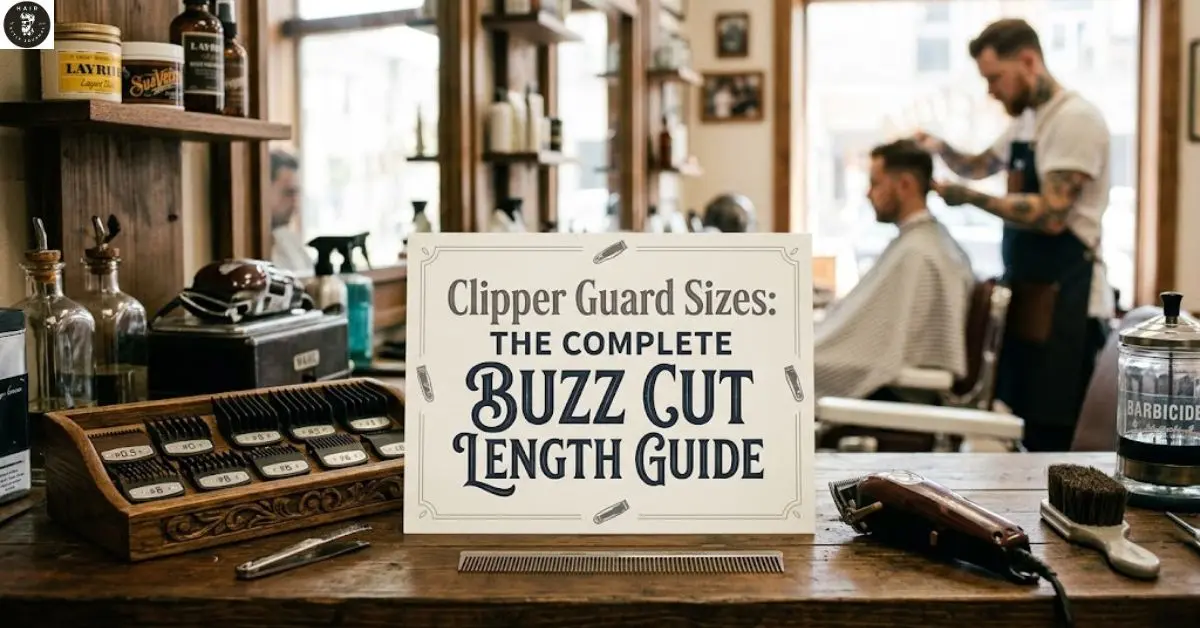
Clipper Guard Sizes: The Complete Buzz Cut Length Guide 2026
Every barber’s clipper case comes with the same lineup of numbered plastic attachments, and every one of those numbers controls exactly how much hair gets left behind.
Get the number right and you walk out with the cut you pictured. Get it wrong, and you’re stuck waiting weeks for it to grow back out.
Hairstyle Journal, this guide breaks down every common clipper guard size — from a bald 0 guard all the way up to a longer 16 guard — so you know exactly what to expect before you sit down in the chair.
Whether you’re chasing a tight, low-maintenance buzz, Clipper Guard Sizes a longer crop with a bit more texture on top, or you’re just trying to translate “guard number” into an actual length you can picture in the mirror, this is the only guard-length reference you’ll need.
How Clipper Guard Sizes Actually Work
A clipper guard is a plastic attachment that clips onto the clipper blade and controls the length of hair left standing after a pass.
The guard doesn’t cut hair to that exact length everywhere — it determines the maximum length the blade can leave, based on how the guard’s teeth space the blade away from the scalp.
Guards are numbered sequentially, and each number typically adds about 1/8 inch (roughly 3mm) of length compared to the one before it, though exact measurements can vary slightly between clipper brands.
Barbers combine guards with technique constantly — going over the same section with two different guards to blend a taper, or switching guards between the top, sides, and back to build a fade.
Understanding what each individual number gives you as a raw length is the foundation for understanding any of those combinations.
Clipper Guard Length Chart
| Guard Number | Length (inches) | Length (mm) | Best For |
|---|---|---|---|
| 0 (no guard) | Skin level | 0mm | Bald fades, skin fade transitions |
| 1 | 1/8″ | 3mm | Tight, low-maintenance buzz |
| 2 | 1/4″ | 6mm | Sharp, clean, classic buzz |
| 3 | 3/8″ | 10mm | Balanced short buzz, most versatile short length |
| 4 | 1/2″ | 13mm | Slightly more texture, still very short |
| 5 | 5/8″ | 16mm | Natural texture starts to show |
| 6 | 3/4″ | 19mm | Visible texture and some styling flexibility |
| 7 | 7/8″ | 22mm | Noticeably fuller, holds curl and wave |
| 8 | 1″ | 25mm | Full crop length, real texture on top |
| 9 | 1 1/8″ | 29mm | Fuller crop, works well for curly or coily hair |
| 10 | 1 1/4″ | 32mm | Longer buzz that can still be styled |
| 12 | 1 1/2″ | 38mm | Approaching a short crop or textured top |
| 14 | 1 5/8″ | 41mm | Long buzz, needs product to hold shape |
| 16 | 1 3/4″ | 44mm | Longest common guard, blurs into a short crop cut |
Guard 0: Skin Level
A 0 guard means no guard at all — the blade goes directly against the skin, leaving nothing behind.
This is what creates a true skin fade or a fully bald section, and it’s almost always used in combination with longer guards elsewhere on the head rather than as a full-head length on its own.
It requires the most frequent touch-ups of any length, since even a few days of regrowth becomes visible as stubble against bare skin.
Guard 1: The Viral Buzz

The 1 guard has become one of the most talked-about lengths online, largely thanks to barber content on TikTok and Instagram showing dramatic before-and-afters.
At just 1/8 inch, it’s about as short as hair can get while still technically having length, sitting right on the edge between a buzz cut and a shaved head.
It suits men who want almost zero daily maintenance and works especially well for showing off a clean hairline or a sharp fade underneath. The trade-off is scalp visibility — thinner or lighter hair will show more scalp at this length than thicker, darker hair will.
Guard 2: Sharp and Clean
A 2 guard keeps things short and crisp without going quite as extreme as a 1. It’s a dependable, no-fuss length that looks intentional every single day without requiring any styling at all.
This length works well across nearly every face shape and hair type, and it’s often the length barbers recommend to first-time buzz cut clients who aren’t sure how short they actually want to go. Regrowth is manageable, typically needing a refresh every two to three weeks.
Guard 3: The Versatile Standard
Often considered the most balanced short length, a 3 guard leaves enough hair to add a bit of natural texture and softness while still reading as a clean, short cut.
It sits at a sweet spot: short enough to be genuinely low-maintenance, but with just enough length that hair doesn’t look painted onto the scalp. This is a strong default choice for anyone unsure which length to request.
Guard 4: A Touch More Texture
At 1/2 inch, a 4 guard starts to show a bit more of your natural hair pattern — waves and curls begin to have room to express themselves, even at this short length.
It remains extremely low-maintenance while giving slightly more visual depth than the shorter guards. This length is popular with men who want the simplicity of a buzz cut without it looking completely uniform and flat.
Guard 5: Natural Texture Emerges

A 5 guard is where texture really starts to become part of the style rather than just a subtle detail. Hair at this length has enough room to show natural movement, and it photographs with more depth than the shorter lengths.
It still requires minimal daily effort, though a small amount of product can help define texture if you want a slightly more polished finish.
Guard 6: Style Flexibility Begins
At 3/4 inch, a 6 guard opens up some genuine styling options for the first time in this list. Hair can be brushed forward, textured up, or left completely natural, and it holds a defined edge or hairline nicely if paired with a fade.
This length works particularly well for men who want the ease of a buzz cut but aren’t ready to commit to something quite as minimal as the shorter guards.
Guard 7: Noticeably Fuller

A 7 guard gives hair enough length to hold curl and wave pattern clearly, making it a strong option for men with naturally textured hair who don’t want that texture completely buzzed away.
It sits comfortably between a true buzz cut and a short crop, offering more personality than the lower numbers while still being fast to maintain.
Guard 8: Full Crop Territory
At a full inch, an 8 guard starts to move out of “buzz cut” territory and into short crop styling. There’s enough length here to add texture with a light product, and hair can be brushed into a rough direction rather than lying uniformly flat.
This is a popular choice for men wanting the low-maintenance appeal of clippers-only cutting with more visual interest than a tighter buzz provides.
Guard 9: Built for Texture

A 9 guard is one of the longer options that still reads as a buzz-adjacent cut. It adds real volume and texture, and it’s particularly well-suited to curly and coily hair types, which need a bit more length to show their natural pattern rather than looking compressed.
Styling becomes optional rather than necessary at this length — natural texture alone often looks finished.
Guard 10: The Long Buzz
At 1 1/4 inch, a 10 guard surprises a lot of people who associate “buzz cut” with something much shorter.
It offers even, all-over length that can still be styled with a small amount of product, and it works well for men transitioning away from a much shorter cut who want to ease into more length gradually.
It also fades nicely into a low, mid, or high fade for extra contrast at the sides.
Guard 12: Approaching a Crop

A 12 guard sits close to where a true short crop or textured top begins. Hair at this length has enough body to be pushed in different directions, and it holds a side part or a light quiff shape with the help of a bit of pomade or gel.
This length needs slightly more frequent trims to maintain its shape compared to shorter guards.
Guard 14: A Long Buzz Cut
At 1 5/8 inch, a 14 guard delivers real length while keeping the simplicity of an all-over clipper cut. Some hairstylists nickname longer guards like this the “forbidden buzz cut,” since it blurs the line between buzz cut and styled crop.
It generally needs product to hold a defined shape and looks best with regular maintenance every few weeks to prevent the ends from looking uneven.
Guard 16: The Longest Common Guard

A 16 guard is about as long as most clipper guard kits go before scissor work takes over. At 1 3/4 inch, hair has enough length for genuine styling — brushed up, side-swept, or left loose with natural texture.
This length suits men who want the even, all-over consistency of a clipper cut but with noticeably more length and versatility than anything shorter on this list.
How to Choose the Right Guard Length
Hair type matters more than the number itself. Straight hair tends to look shorter at any given guard length than curly or coily hair, since curl pattern adds visual volume that clipper length alone doesn’t capture.
If you have thick, curly, or coily hair, consider sizing up one or two guard numbers from what a straight-haired friend might choose for a similar look.
Face shape affects how short is too short. Rounder faces often benefit from a bit more length on top (guard 6 and above) to avoid emphasizing width, while more angular or oval faces can comfortably wear the shorter guards without issue.
Lifestyle and maintenance tolerance should guide your decision. Lower guard numbers (1 through 4) need touch-ups roughly every two weeks to stay sharp, since regrowth is more visible at shorter lengths.
Guards from 8 upward can often stretch to four or five weeks between trims before the shape starts to look uneven.
Think about fades and combinations. Most of these guard lengths aren’t used alone — they’re combined with a 0 guard or skin-level fade at the sides for contrast, or blended into a taper.
Choosing your top length first, then discussing fade options with your barber, is usually the easiest way to land on a complete look.
What to Tell Your Barber
Rather than just naming a guard number, describe the finished look you want and let your barber translate that into the right length and technique.
Useful details to mention include how much maintenance you’re willing to do between visits, whether you want any fade or taper at the sides, and whether you’re growing your hair out or maintaining a length long-term.
Bringing a reference photo also helps enormously, since the same guard number can look different depending on hair density, texture, and how the barber blends it.
Maintenance and Growth Timeline
Shorter guards (1 through 4) grow out fastest in terms of visible change, since even a small amount of regrowth is proportionally significant at such short lengths — expect to book a refresh every two to three weeks.
Mid-range guards (5 through 9) offer a bit more forgiveness, generally holding their shape for three to four weeks.
Longer guards (10 through 16) can often go four to six weeks between trims, since the added length hides regrowth more effectively and there’s more room for the shape to grow out gracefully rather than looking immediately uneven.
My Final Thoughts:
Clipper guard numbers might look like a simple, arbitrary scale, but each one represents a distinct length with its own maintenance needs, styling potential, and best-fit hair types.
Whether you’re after the ultra-low-maintenance simplicity of a 1 or 2 guard, the balanced versatility of a 3 through 6, or the styling flexibility of a longer 8 through 16, matching the right number to your hair type, face shape, and lifestyle is the key to walking out of the barbershop with a cut you’ll actually want to maintain.
FAQs
What guard length is best for a first-time buzz cut?
A 2 or 3 guard is generally the safest starting point — short enough to feel like a genuine change, but not so short that hair disappears completely or shows every contour of the scalp.
Do guard numbers mean the same length on every clipper brand?
Most major clipper brands follow a similar 1/8 inch increment per guard number, but small variations exist between manufacturers, so it’s worth confirming with your barber if you’re particular about an exact length.
Which guard length works best for curly or coily hair?
Guards 7 and above tend to work better for curly and coily hair, since shorter lengths can compress natural curl pattern and make hair look tighter to the scalp than intended.
How often do I need a trim to maintain a specific guard length?
Shorter guards (1 to 4) typically need a refresh every two to three weeks, while longer guards (10 and above) can usually stretch to four to six weeks between trims.
Can I combine two different guard lengths in one haircut?
Yes — this is exactly how fades and tapers are created, using a shorter guard (or no guard at all) at the sides and back and a longer guard on top, blended together for a gradual transition.

I’m M Ahmad Ansari, founder and content creator at HairstyleJournal. With 3+ years of experience researching hairstyles, haircuts, and men’s grooming, I create practical, easy-to-understand content to help readers choose, style, and maintain the right haircut with confidence.